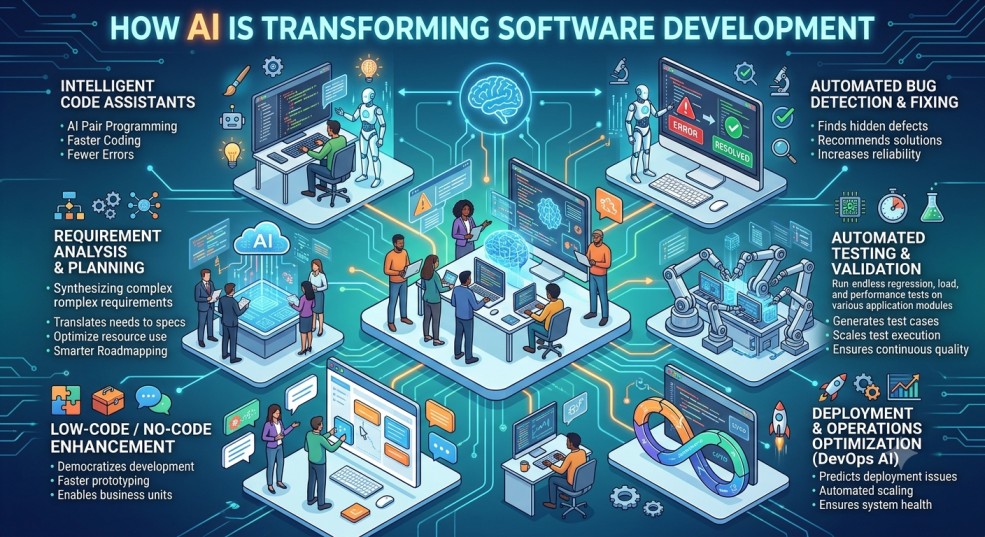
How AI Is Transforming Software Development
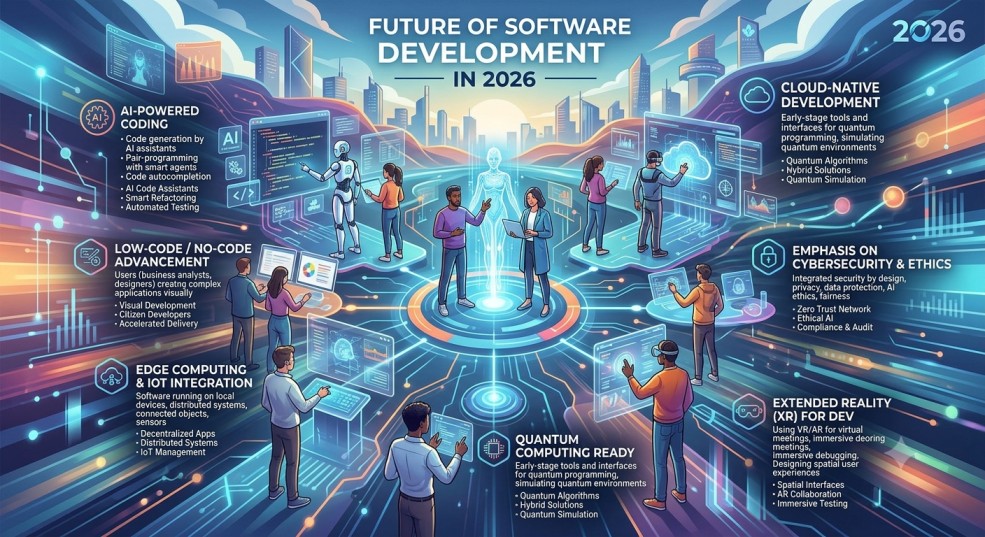
Artificial Intelligence (AI) and its subset, Machine Learning (ML), are not just features within software; they are fundamentally reshaping the entire software industry, moving the paradigm from reactive programming to proactive and predictive systems. The impact of AI is two-fold: enhancing the development process itself and transforming the capabilities of the final applications. In the development lifecycle, AI-powered tools are now acting as intelligent assistants. They can perform sophisticated tasks such as suggesting code completions (beyond basic syntax), automatically generating boilerplate code, and even detecting potential bugs or security vulnerabilities during the coding process. This automation significantly boosts developer productivity, reduces human error, and allows teams to focus on complex, high-value problem-solving.
On the application front, ML models are the core engines driving innovation. These models analyze vast, complex datasets to deliver highly personalized experiences and predictive insights. Applications ranging from sophisticated recommendation engines (for retail or media platforms) to intelligent chatbots for customer service, and advanced fraud detection systems, all rely on robust AI integration. These AI-driven features dramatically improve efficiency, customer engagement, and operational intelligence. The ability to forecast trends, automate complex decision-making, and personalize user journeys is now a competitive necessity.
However, successfully integrating AI into software demands stringent technical and ethical considerations. Strong data management is paramount, requiring clean, unbiased, and securely stored data to train accurate ML models. Furthermore, the integration must adhere to growing concerns regarding ethical AI. Developers must ensure that models are fair, transparent, and comply with privacy regulations (like GDPR). As AI technologies, particularly large language models (LLMs), continue to advance rapidly, they are becoming an absolutely essential, non-negotiable component of modern software solutions. The future of software is inextricably linked to AI—it is the engine of digital innovation, creating systems that are not just functional but genuinely intelligent and adaptive.
The Hilarious Glitches of Gamedev: When Code Becomes a Comedian
The world of game development is often where the most peculiar and genuinely funny software glitches arise, turning mundane errors into accidental features or viral moments. These comical bugs often stem from the complex interplay between the physics engine, character animation systems, and collision detection. For example, a minor error in a character's animation rigging can cause limbs to stretch wildly , transforming a fearsome enemy into a surreal, elastic noodle. Similarly, logic errors in object spawning or despawning, combined with an overwhelmed game engine, can lead to absurd scenarios like an "Infinite Chicken Apocalypse," where livestock multiplies exponentially until the game crashes, demonstrating how a small typo can lead to catastrophic, yet hilarious, chaos. Historically, some unintentional bugs have even become beloved features, such as the increasing speed of aliens in the original Space Invaders, which was a technical limitation of the hardware becoming an embraced difficulty mechanic, proving that sometimes, code’s humor adds unexpected value.
How AI Is Transforming Software Development
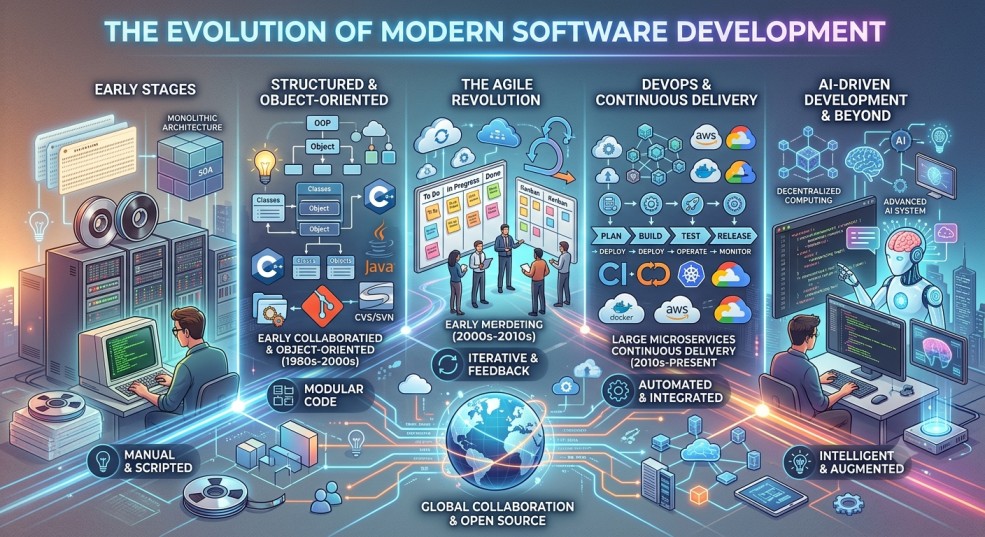
Artificial Intelligence, particularly generative AI (GenAI) and Large Language Models (LLMs), is fundamentally reshaping the software development lifecycle (SDLC) from end-to-end, enhancing productivity, accuracy, and innovation. The primary impact is the automation of routine and boilerplate tasks, which allows developers to shift their focus to higher-value activities like solution architecture, complex problem-solving, and creative design. AI tools now assist across all stages of the SDLC: generating initial requirements and documentation, providing real-time code suggestions and synthesis in IDEs, automatically creating comprehensive test cases, identifying security vulnerabilities, and optimizing CI/CD pipelines. This augmentation has been shown to deliver significant productivity gains—upwards of 25%—and transforms the developer's role from a primary code producer to a supervisor and director of AI-generated code. Consequently, the new essential skills for developers are less about syntax memorization and more about prompt engineering, verification of AI outputs, and understanding large-scale systems architecture .