Digital Transformation is not merely a buzzword; it's an imperative for businesses aiming to remain competitive and relevant in an increasingly technology-driven world. As we look towards 2025, the pace of this transformation is only accelerating, driven by advanced technologies and evolving customer expectations. Organizations that have not fully embraced digital strategies risk obsolescence. The journey involves a holistic rethinking of operations, culture, and customer engagement, powered by cutting-edge digital tools and methodologies.
One of the most significant drivers in 2025 will be the pervasive integration of Artificial Intelligence (AI) and Machine Learning (ML) across all business functions. AI will move beyond basic automation to intelligent process optimization, predictive analytics, and hyper-personalized customer experiences. From AI-powered chatbots handling complex queries to ML algorithms optimizing supply chains and informing strategic decisions, intelligence will be embedded at every level. This requires a robust data strategy to ensure AI models are fed clean, relevant, and ethical data.
Cloud computing will continue its dominance, with an increasing shift towards multi-cloud and hybrid-cloud strategies to maximize flexibility, resilience, and cost-efficiency. Cloud-native development and serverless architectures will become standard, enabling faster innovation and unparalleled scalability. This infrastructure empowers the rapid deployment and management of complex applications, supporting dynamic business needs. Furthermore, the focus on hyper-automation will intensify, leveraging AI, Robotic Process Automation (RPA), and intelligent business process management (iBPM) to automate repetitive tasks and optimize workflows end-to-end.
Enhanced Customer Experience (CX) will remain a top priority, with digital transformation efforts directly impacting how customers interact with brands. This includes leveraging data to understand customer journeys, providing seamless omnichannel experiences, and offering proactive, personalized services. Finally, the foundational element for successful digital transformation in 2025 will be an Agile organizational culture. This fosters continuous learning, adaptability, cross-functional collaboration, and a willingness to experiment and iterate, ensuring that technology investments yield tangible business value and drive sustainable growth. Digital transformation is a continuous journey, not a destination, demanding constant evolution and strategic foresight
Digital Transformation in 2025
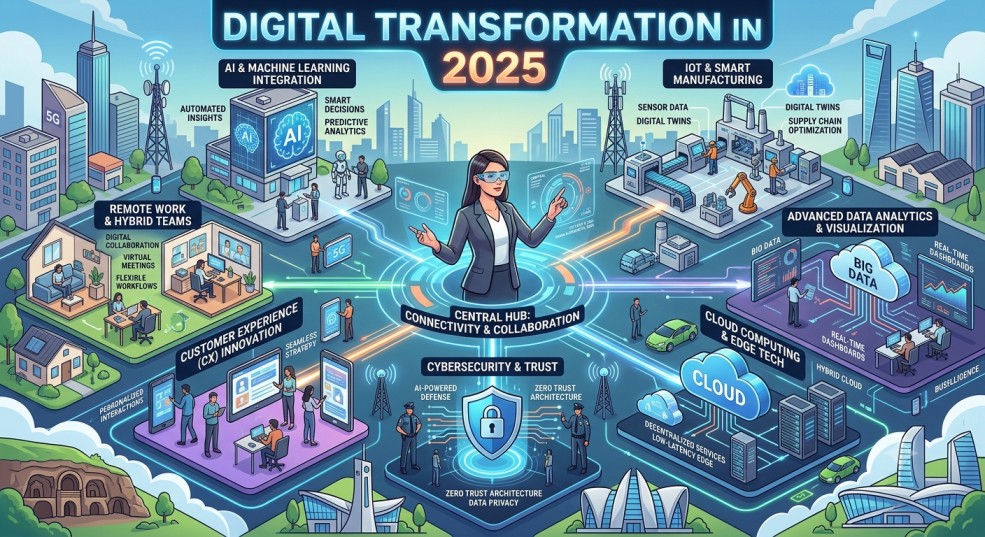
Navigating 2025: Key Trends in Digital Transformation Digital Transformation is an ongoing journey. Discover the critical trends shaping how businesses will evolve, innovate, and leverage technology to thrive in 2025 and beyond.