In today's highly distributed and interconnected digital landscape, the traditional perimeter-based security model—where everything inside the network is trusted—is no longer sufficient. This outdated approach leaves organizations vulnerable to sophisticated threats that can easily bypass the perimeter once an initial breach occurs. The emergence of remote work, cloud computing, and mobile access has rendered the concept of a definable, secure "inside" and an untrusted "outside" obsolete.
This is precisely where Zero Trust Security Architecture steps in, revolutionizing how organizations approach network and data protection.\n\nThe core principle of Zero Trust is "never trust, always verify." It dictates that no user, device, or application, whether internal or external to the corporate network, should be implicitly trusted. Every single access request, regardless of its origin, must be authenticated, authorized, and continuously validated before access is granted. This approach significantly minimizes the attack surface and prevents lateral movement of threats within the network.\n\nImplementing Zero Trust involves several key pillars.
Identity verification is paramount, ensuring that every user and device accessing resources is positively identified through multi-factor authentication (MFA) and robust identity management systems. Least privilege access is strictly enforced, meaning users are granted only the minimum level of access required to perform their specific tasks, and this access is revoked when no longer needed.
Microsegmentation is another crucial component, which involves breaking down security perimeters into small, isolated zones to limit the blast radius of any potential breach.\n\nFurthermore, continuous monitoring and analytics are employed to detect anomalous behavior and potential threats in real-time. All network traffic, user activities, and device states are logged and analyzed to identify deviations from normal patterns. Automated response mechanisms can then isolate compromised entities or revoke access dynamically. Data protection is central, with encryption applied to data both in transit and at rest. By adopting a Zero Trust model, organizations can establish a much stronger security posture, safeguarding sensitive data and critical assets against an ever-evolving threat landscape, ultimately building resilience in a perimeter-less world. It's a proactive, adaptive strategy that is fast becoming the gold standard for enterprise security.
Zero Trust Security Architecture
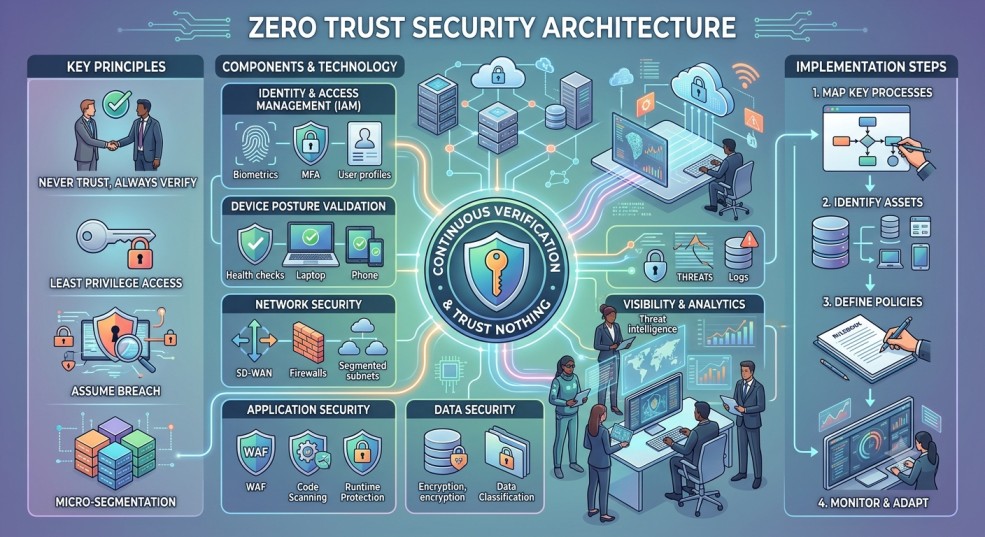
Adopt Zero Trust: Securing Networks in a Perimeter-less World "Never trust, always verify" is the mantra of Zero Trust. Learn how this architecture protects modern enterprises by eliminating implicit trust and verifying every access request.