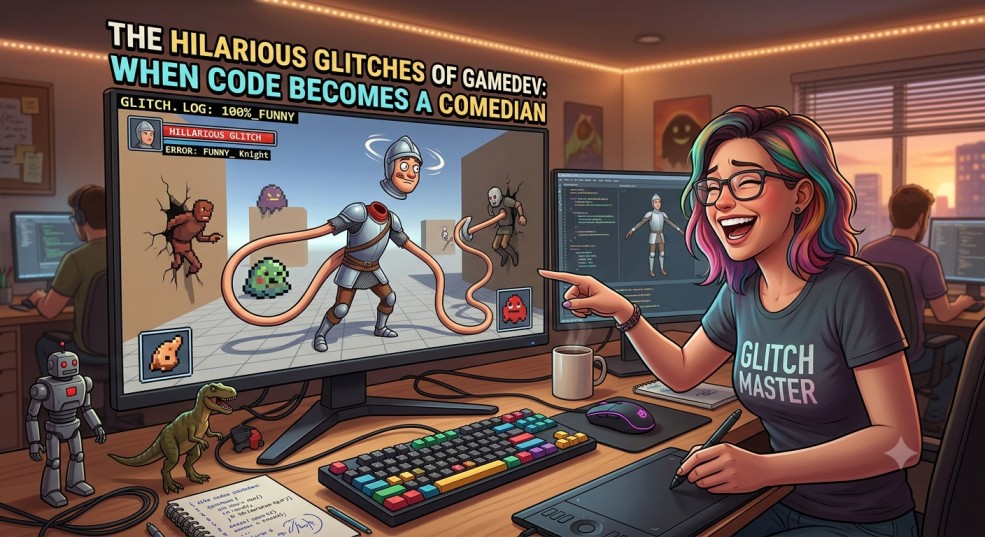
Today, we're taking a joyride through some of the most ridiculous, bizarre, and downright hilarious glitches that arise when digital worlds go a little… off-script. Get ready to cringe, chuckle, and perhaps shed a tear of recognition!
Case 1: The Rubber Band Man (or Dragon)
Imagine you're developing a grand fantasy RPG. You've painstakingly designed a fearsome dragon, a majestic beast of fire and scale. You implement its movement, its fire breath, its intimidating roar. All good.
Then, during a routine test, you trigger its "take damage" animation. Instead of a dignified flinch, its limbs suddenly stretch across the entire screen, its neck elongates into a spaghetti noodle, and its majestic wings flap like distressed elastic bands. It's less "terrifying dragon" and more "abstract modern art interpretation of a dragon having an existential crisis."
The Bug Culprit: Often, this is a physics engine hiccup combined with animation rigging. Maybe a bone constraint broke, or a collision detection went wild, telling the character model to stretch itself into oblivion. The game engine, bless its heart, just tries its best with the confusing instructions.
The Laugh Factor: High. What was meant to be epic becomes epically silly. The player is left wondering if they're fighting a dragon or auditioning for a Cirque du Soleil show.
Case 2: The Infinite Chicken Apocalypse
You're programming a simple farming simulator. Players need to collect eggs, raise livestock, etc. You've implemented a "chicken lay egg" function and a "chicken despawn after X time" function. What could go wrong?
Turns out, the despawn function had a tiny, almost invisible typo. Instead of despawn_time = 60, it was despawn_time = -1 (or some other value that essentially meant "never"). The "lay egg" function, however, worked flawlessly.
Suddenly, your tranquil farm is overrun. Chickens appear faster than you can count them. They clip through fences, stack on top of each other, forming feathered mountains. The framerate drops to single digits, and the only sound is the ceaseless, digital cluck, cluck, cluck of an impending poultry apocalypse. The serene farm has become a fever dream of clucking chaos.
The Bug Culprit: A logic error in timing or a misplaced conditional statement. The game thinks it needs more chickens, not fewer, and happily obliges until the engine screams for mercy.
The Laugh Factor: Builds from amused confusion to outright panic-laughing as the sheer volume of digital poultry becomes overwhelming.
Case 3: Objects on a High
Physics engines are amazing until they decide to become stand-up comedians. You're building a tavern scene for your RPG. Barrels, mugs, chairs, all neatly placed. You hit play, and for a glorious second, everything is perfect.
Then, BAM! A mug rockets into the ceiling. A barrel decides to spin wildly on its axis before launching itself through a wall. The chairs start vibrating, threatening to achieve lift-off. Soon, the entire tavern is a zero-gravity disco of flying furniture, defying every known law of physics. The solemn barkeep remains perfectly still, oblivious to the chaos as a tankard slowly orbits his head.
The Bug Culprit: Often, it's a minor collision mesh error, a tiny overlap between two objects upon scene load, or an incorrectly tuned physics property (like too much bounciness or an unstable joint). The engine tries to resolve the "interpenetration" with force, leading to hilarious explosions of inanimate objects.
The Laugh Factor: Visual slapstick at its finest. It's like watching a magic show where the magician accidentally makes everything float, but only for a few seconds before it all crashes down.
Case 4: The Hero Who Forgot How to Stand
Character animation is tough. You have idle animations, walk cycles, attack animations. Sometimes, the game gets confused about which one to play, or transitions awkwardly.
This leads to the hero of your epic quest, after vanquishing a terrifying monster, deciding to T-pose majestically into the sunset. Or perhaps they finish a powerful spell, only to have their legs stretch horizontally while their torso remains upright, resulting in a surreal breakdancing move. My personal favorite is when they accidentally blend the "falling" animation with the "walking" animation, causing your character to moonwalk while slowly sinking through the floor.
The Bug Culprit: Animation state machine errors, incorrect blending weights, or a missing animation file causing a fallback to a default (like the T-pose). The character rig is trying to do its job, but the instructions are all jumbled.
The Laugh Factor: The incongruity of an epic moment clashing with utterly broken visual fidelity is priceless. It reminds us that even heroes are just collections of vertices and bones under the hood.
Conclusion: Embracing the Accidental Comedy
While these glitches can be head-deskingly frustrating for developers, they also serve as fantastic reminders of the intricate and often unpredictable nature of software. They're a testament to the immense complexity we wrangle every day, and a well-deserved opportunity to laugh at ourselves and the digital worlds we painstakingly create.
So, the next time your code decides to be a comedian instead of a calculator, take a moment to appreciate the accidental humor. Who knows, maybe your next bug will be the star of its own viral GIF!